
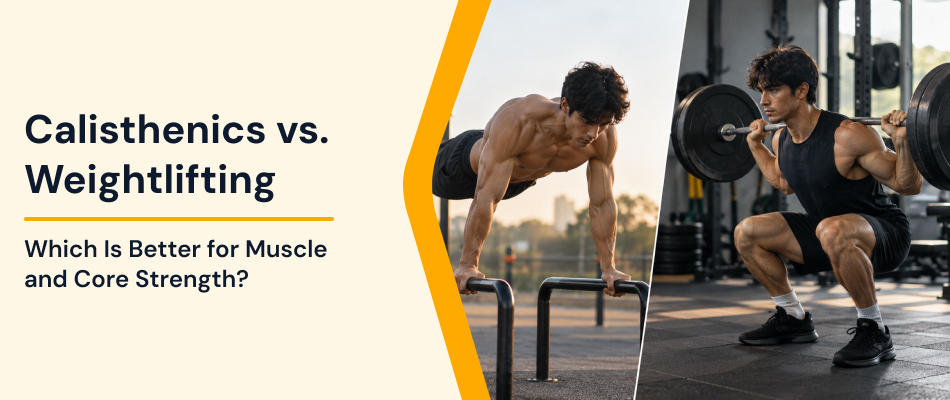
When you decide to build strength and muscle, you face an important choice. Should you do calisthenics using your own bodyweight? Or should you lift weights? Both methods work. Both have advantages, as well as limitations. The real question is which one is better for you.
At the Institute of Nutrition and Fitness Sciences (INFS), we explain how calisthenics and weightlifting work so you can choose or combine both methods for your fitness goals. This guide breaks down the science to help you build an effective training program.
What Is Calisthenics? Understanding Bodyweight Training
Calisthenics is strength training using your own body weight as resistance. The word comes from Greek: “kalos” (beauty) and “sthenos” (strength). It is training that builds both.
Common calisthenics exercises include:
-
Push-ups and variations
-
Pull-ups and chin-ups
-
Squats and lunges
-
Planks and core work
-
Dips and leg raises
-
Handstand holds and movements
The core principle is simple: your body provides the resistance. No barbells. No dumbbells. No machines. Just you, gravity, and progressive challenge.
Calisthenics has roots in military training, gymnastics, and street fitness culture. Today, it is recognized as a legitimate training method backed by scientific research.
The key difference from weightlifting is the tool. With calisthenics, you control difficulty by changing your body position, increasing repetitions, or slowing the movement. With weights, you control difficulty by adding or removing load from a barbell or dumbbell.
Can You Build Muscle With Calisthenics?
Yes. When discussing calisthenics vs weightlifting for muscle growth, the evidence is clear, both methods work effectively. The key is understanding how muscle growth happens.
Muscle grows when you create tension and challenge your muscles. This challenge can come from bodyweight exercises or external weights. A well-designed push-up programme can build muscle. A well-designed bench press programme can also build muscle.
Research shows that muscle hypertrophy occurs with both methods when you follow progressive principles. You need progressive challenge. You need adequate recovery. You need proper nutrition. The tool does not matter as much as the principle behind it.
-
For beginners, bodyweight exercises like push-ups, pull-ups, and squats are often easier to learn. They have lower injury risk. You can start immediately without equipment.
-
For advanced trainees, weights offer more precise control and easier progression. You can add 2.5 kilograms to a barbell. With calisthenics, you must increase reps, slow movements, or progress to harder variations.
Weightlifting and Maximum Strength: Where External Weights Win
When comparing bodyweight exercises vs weight training for pure maximal strength, weightlifting has a clear advantage.
How Weights Allow Clear Progression
External weights allow precise progression. Key benefits:
-
Load weight in small increments (2.5 kg, 5 kg, etc.)
-
Measure progress easily and track it week to week
-
See clear results: squat 100 kg → 102.5 kg → 105 kg
-
Get simple, objective measurement of strength gains
Why Calisthenics Progression Is Harder to Track
Calisthenics progression for strength is harder to measure. Your options include:
-
Do more repetitions
-
Change leverage to make movements harder
-
Use resistance bands
-
Progress to advanced variations
These methods work, but tracking is less precise. Without clear numbers, it’s harder to know if you’re actually getting stronger.
The Efficiency Difference
For raw maximal strength gains, weighted training is more efficient. If your goal is to become as strong as possible, weights provide better tools. Many athletes use weights specifically because they need to develop maximal strength for their sport or profession.
Bodyweight Still Builds Real Strength
That said, bodyweight training can still build considerable strength. Advanced calisthenics athletes performing one-arm pull-ups or handstand push-ups demonstrate impressive strength.
The difference is efficiency. Weights get you there faster and with clearer progression.
Core Strength: Understanding Why It Matters
Core strength is more than visible abs. Your core is your bodys stability system made up of abdominal muscles, back muscles, and deep stabilizer muscles. A strong core improves posture, reduces injury risk, and boosts athletic performance. Both calisthenics and weightlifting build core strength, but in different ways.
-
Push-ups and pull-ups build functional stability. Your core works continuously to keep your body straight and prevent swinging. This builds real-world strength you use every day.
-
Squats, deadlifts, and overhead presses build maximum core strength. Heavy weight forces your core to work harder and get stronger faster.
-
Calisthenics is better for daily movement stability. It teaches your core to work dynamically in real situations.
-
Weightlifting is better for heavy lifting strength. If you want to lift heavy things, weights train your core more efficiently.
-
Both methods are effective. The choice depends on what you need : stability or maximum strength.
-
Your core needs both types of training. Combining calisthenics and weights gives you the best core strength.
Progressive Overload: The Principle That Matters Most
Progressive overload means gradually increasing the challenge to your muscles. This is the most important principle for muscle growth, regardless of method.
With weights, progressive overload is straightforward. You add weight to the bar. You do more sets. You reduce rest periods. Each week, something increases.
With calisthenics, progressive overload is less obvious but equally important. You do more repetitions. You slow down the movement. You change your leverage to make it harder. You add resistance bands. You perform more advanced variations. A beginner does push-ups. An intermediate lifter does diamond push-ups. An advanced athlete does one-arm push-ups.
The confusion happens when people think that calisthenics plateaus. It does not plateau if you understand progression. But progression becomes creative. You must constantly find new ways to challenge your muscles.
This is why many fitness professionals use both methods. They understand that the best knowledge comes from structured online nutrition certification program training combined with practical exercise experience. They use weights for clear progression in absolute strength. They use calisthenics for functional movement and accessible training. Together, they cover all bases.
Is Calisthenics Safer Than Lifting Weights? Accessibility and Injury Risk Compared
Calisthenics has a major advantage. It is accessible. You need no equipment. You need no gym membership. You can train anywhere.
For beginners, calisthenics is often safer. You control the weight, your own body. You can easily reduce difficulty. Cannot do a full push-up? Do a modified version with knees on the ground. Calisthenics scales naturally.
Weightlifting requires proper form instruction, especially with heavy weights. Poor form can cause injury. A heavy barbell dropped on your body hurts. Calisthenics has lower injury risk for beginners.
That said, weightlifting is safe when done correctly. Many people train with weights for decades without injury. It requires proper instruction and respect for the weight.
For accessibility and ease of entry, calisthenics wins. For precision and control, weights win.
The Best Approach: Combining Both Methods
The question should not be "which one is better?" Instead, ask "how can I use both smartly?" Many successful athletes and fitness professionals combine calisthenics and weightlifting. They use weights for specific strength goals and heavy progression, while they use calisthenics for functional movement, accessibility, and varied stimulus. A practical approach is to dedicate 70% of your training to your chosen method, then spend 20-30% on the other method. This gives you the best of both worlds.
Method 1: For Strength Trainers
Spend 70% of your time lifting weights for clear progression and maximal strength. Spend 20% doing bodyweight strength work like push-ups and pull-ups to build functional stability. Spend 10% on mobility and recovery to stay healthy and prevent injuries.
Method 2: For Calisthenics Athletes
Spend 70% doing advanced bodyweight movements to master functional skills and progress naturally. Spend 20% lifting weights for specific strength gains that support your calisthenics. Spend 10% on accessory work and recovery to maximize your results.
Conclusion
Your fitness journey is unique. Whether you choose calisthenics, weightlifting, or a combination of both, the most important step is to start and stay consistent. Science-backed training combined with proper nutrition and recovery will get you real, lasting results.
Ready to take the next step?
-
Explore our Calisthenics Trainer Certification to build expertise:
-
Deepen your knowledge with our Nutrition & Fitness Courses
Connect with INFS today to create your personalized training roadmap
Key Takeaways
-
Both calisthenics and weightlifting can build muscle effectively when programmed correctly.
-
Weightlifting provides clearer progression for maximal strength development.
-
Calisthenics offers accessibility, lower injury risk, and functional stability building.
-
Progressive overload, the core principle, matters more than the tool you use.
-
Core strength develops through both methods, with different benefits for each.
-
Combining both methods gives you advantages of each approach.
-
Your choice depends on your goals, experience level, and available resources.
-
A combined approach using both methods is often most effective for long-term results.
Frequently Asked Questions
Look for certified programs through recognized fitness organizations covering anatomy, exercise science, nutrition, and program design. The Institute of Nutrition and Fitness Sciences (INFS) offers a comprehensive Calisthenics Trainer Certification.
Master bodyweight progressions through consistent practice, pull-ups, handstands, muscle-ups, and progressive calisthenics movements. Build real-world experience by training yourself and friends, documenting transformations, and starting small with a local community or gym. Learn from INFS resources and coaches who specialize in functional movement and program design. Establish credibility through social media, YouTube tutorials, or workshops before scaling to full-time coaching. Your ability to demonstrate results and teach progressions is what builds lasting reputation.
Disclaimer
This article is for educational purposes only and is not a substitute for professional medical advice. Always consult your doctor, registered dietitian, or certified fitness professional before starting any new exercise program or making significant dietary changes, especially if you have pre-existing health conditions, injuries, or are on medications.
References
-
Schoenfeld BJ. The Mechanisms of Muscle Hypertrophy and Their Application to Resistance Training. Journal of Strength and Conditioning Research. 2010;24(10):2857–2872.
-
Lasevicius T, et al. Muscle Failure Promotes Greater Muscle Hypertrophy in Low-Load But Not in High-Load Resistance Training. Journal of Strength and Conditioning Research. 2018;32(12):3476–3486.
-
Kotarsky CJ, et al. Effect of Progressive Calisthenics on Upper Limb Strength. Journal of Applied Physiology. 2018;125(4):985–993.
-
Willardson JM. The Application of Training to Failure in Periodized Multiple-Set Resistance Exercise Programs. Journal of Strength and Conditioning Research. 2007;21(3):628–631.