
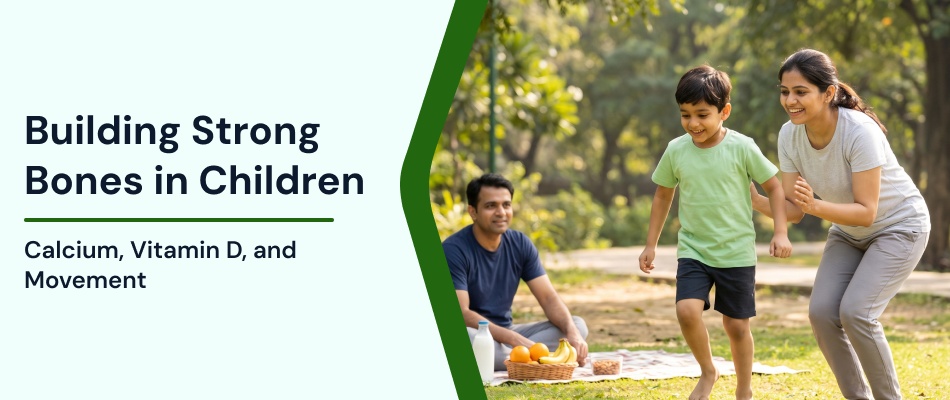
Childhood and adolescence are the most important years for building strong bones. The bone a child builds while growing helps decide how strong their bones will be as adults, and how likely they are to break a bone or develop osteoporosis later in life
Three things work together to build strong bones: enough calcium, enough vitamin D and regular movement that puts weight on the bones. They work as a team rather than on their own, so it helps to think about all three at once.
The Institute of Nutrition and Fitness Sciences (INFS) offers a Kids and Adolescent Nutrition course that explains how nutrition supports healthy growth in children and teenagers.
Why Childhood Bone Health Matters
Bone is living tissue. Throughout life, the body breaks down old bone and builds new bone. During growth, building happens faster than breaking down. This allows children to gain
-
Bone Mineral Content (BMC), which is the amount of mineral in their bones, and
-
Bone Mineral Density (BMD), which is how tightly that mineral is packed.
The highest level of bone strength a person reaches is called peak bone mass in childhood. Roughly half of adult bone mass is built during the teenage years . A child who builds less during growth starts adulthood with less to spare.
Several factors affect how much bone a child builds: genetics, sex, puberty, hormones, nutrition and physical activity. Genes cannot be changed, but nutrition and movement can. That makes them the most practical areas to focus on .
Calcium: The Building Block
Calcium is the main mineral in bone. It forms a crystal called hydroxyapatite, which gives bone its hardness. Dietary calcium supports this mineralization process. When children get too little calcium during fast growth, their bones may not build as much strength as they could .
Calcium needs change with age:
|
Age group |
Calcium per day (approx) |
|
Babies, 0 to 6 months |
200 mg |
|
Babies, 6 to 12 months |
260 mg |
|
Children, 1 to 3 years |
700 mg |
|
Children, 4 to 8 years |
1,000 mg |
|
Preteens, teens and young adults, 9 to 18 years |
1,300 mg |
|
Pregnant and breastfeeding adults |
1,000 mg |
Source: National Institute of Health Office of Dietary supplements
Good calcium rich foods for kids include milk, curd (yogurt), paneer, cheese, ragi (finger millet), sesame seeds (til), almonds and green leafy vegetables.
Calcium helps most when a childs usual intake is low. Good nutrition for gut health and digestion also helps the body make the most of the calcium a child eats. One study found that calcium intake predicted bone measures, especially among children who got less than 800 mg a day. The link was weaker at higher intakes . So the children who benefit most from extra calcium are those who are not already getting enough.
Vitamin D: The Helper
Calcium and vitamin D for kids bone health work as a pair :
-
Calcium supplies the building material.
-
Vitamin D helps the body absorb calcium and phosphate, and use them to harden bone.
Without enough vitamin D, calcium from food is not used well. Severe deficiency can cause rickets, which weakens bones, causes skeletal deformities and makes fractures more likely.
What are the vitamin D requirements for growing bones?
-
Babies in their first year: 400 IU a day
-
Children and teenagers aged 1 to 18: 600 IU a day .
The Endocrine Society’s 2024 guideline suggests vitamin D supplements for children and teenagers aged 1 to 18 when diet or sun exposure is not enough to prevent rickets.
What affects vitamin D levels?
Most vitamin D comes from sunlight, fortified milk, eggs and oily fish. The amount the body makes depends on:
-
Skin colour
-
Where the family lives
-
The season
-
Sunscreen and clothing
-
Time spent outdoors
-
Diet
Some children may need a check and targeted supplements from a doctor. This includes children with limited sun exposure, darker skin, malabsorption conditions, obesity or restricted diets.
Too much vitamin D can also cause problems, so always check with a doctor before giving supplements.
Movement for Stronger Bone
Bones respond to the forces placed on them. Impact, muscle pull and varied movement stimulate bone-building cells. Scientists call this process mechanotransduction, which means the body turns physical force into a signal to build bone . Walking, running, jumping, hopping, climbing, dancing and resistance exercise are especially useful. This is why weight bearing exercises for children matter so much.
The World Health Organization (WHO) recommends that children and teenagers aged 5 to 17 get at least 60 minutes a day of moderate to vigorous physical activity. On at least 3 days a week, this should include activities that strengthen muscle and bone . A practical weekly plan looks like this:
-
Every day: At least 60 minutes of enjoyable activity, such as brisk walking, cycling, swimming, football or active play.
-
3 days a week: Jumping, hopping, skipping, running, basketball, gymnastics or dance.
-
3 days a week: Age-appropriate strength work, such as climbing, bodyweight exercises or supervised resistance training.
-
Variety: Jumping, changing direction, landing and team sports load bone in more ways than repeating one movement.
Research shows that children who are more physically active tend to have stronger bones in late puberty. Vigorous activity appears especially useful for building bone minerals. The years just before and during puberty may be a particularly good window for weight-bearing exercise . This can support peak bone mass in childhood.
Screen time often replaces this kind of play. This guide on how much screen time is too much for a growing child explains how to find a healthy balance.
Other Nutrients and Habits That Support Bones
Calcium, vitamin D and movement are the core. Strong bones also need enough:
-
Protein
-
Energy (calories)
-
Vitamin K
-
Vitamin C
-
Magnesium
-
Phosphorus
Children who eat too little, skip meals or train hard without enough energy can build less bone and face a higher risk of injury. Restrictive eating and disordered eating are serious concerns and should be discussed with a doctor.
Habits That Work Against Bone Health
Some habits can weaken bones over time:
-
Drinking too many sugary drinks in place of nutritious foods
-
Having too much caffeine
-
Smoking
-
Spending long periods sitting still
A balanced diet and daily movement protect bones better than any single supplement. For ideas on building good eating habits, read healthy eating habits for kids: an easy parent guide.
Conclusion
Building strong bones in children starts with simple daily habits. Calcium from food, vitamin D for absorption and movement that loads the bones work together. Small habits, repeated every day, add up to a lot of bone over the years.
Start with a few steps:
-
Include a calcium-rich food at every meal
-
Make sure your child spends time outdoors in daylight
-
Encourage at least 60 minutes of active play each day
-
Include jumping and climbing at least 3 days a week
-
Limit sugary drinks and long periods of screen time
If you want to study children’s nutrition in depth, a certified nutrition course is a good next step. You can explore these options at the Institute of Nutrition and Fitness Sciences (INFS):
-
Kids and Adolescent Nutrition: a course on feeding children and teenagers for healthy growth.
-
Basic Course in Nutrition and Fitness: a foundation course in healthy eating and active living
Disclaimer
The information in this blog is for general educational purposes only. It is not a substitute for professional medical advice, diagnosis or treatment. Always speak with a qualified doctor or healthcare professional before starting, stopping or changing any diet, supplement or exercise programme for a child, especially if your child has an existing medical condition or takes regular medication.
Frequently Asked Questions
1. What vitamins are good for bone growth in kids?
2. Which vitamins increase bone density?
3. Which food makes bones stronger?
No single food does it alone. Milk, curd, paneer and other calcium-rich foods supply the building material. Eggs, fortified milk and oily fish provide vitamin D. Combined with daily play and sport, these foods help bones grow strong.
4. How much calcium does a child need every day?
5. Is sunlight enough for a child’s vitamin D?
6. How much physical activity do children need for strong bones?
7. When is peak bone mass built?
Roughly half of adult bone mass is built during the teenage years. This is why childhood and adolescence matter so much. The bone a child builds during these years sets the foundation for their bone strength as an adult.
References
1.Faienza MF, Urbano F, Chiarito M, Lassandro G, Giordano P. Musculoskeletal health in children and adolescents. Front Pediatr. 2023;11:1226524. doi:10.3389/fped.2023.1226524
2. Wojtys EM. Bone Health. Sports Health. 2020;12(5):423–424. doi:10.1177/1941738120948734
3. Proia P, Amato A, Drid P, Bianco A, Baldassano S. The Impact of Diet and Physical Activity on Bone Health in Children and Adolescents. Front Endocrinol. 2021;12:704647. doi:10.3389/fendo.2021.704647
4. Demay MB, Pittas AG, Bikle DD, et al. Vitamin D for the Prevention of Disease: An Endocrine Society Clinical Practice Guideline. J Clin Endocrinol Metab. 2024;109(8):1907–1940. doi:10.1210/clinem/dgae290
5. Abrams SA. Normal Acquisition and Loss of Bone Mass. Horm Res Paediatr. 2003;60(Suppl. 3):71–76. doi:10.1159/000074505
6. National Institutes of Health, Office of Dietary Supplements. Calcium: Fact Sheet for Health Professionals. Available from: https://ods.od.nih.gov/factsheets/Calcium-HealthProfessional/
7. National Institutes of Health, Office of Dietary Supplements. Vitamin D: Fact Sheet for Health Professionals. Available from: https://ods.od.nih.gov/factsheets/VitaminD-HealthProfessional/
8. World Health Organization. WHO Guidelines on Physical Activity and Sedentary Behaviour. Geneva: World Health Organization; 2020. Available from: https://www.who.int/publications/i/item/9789240015128