
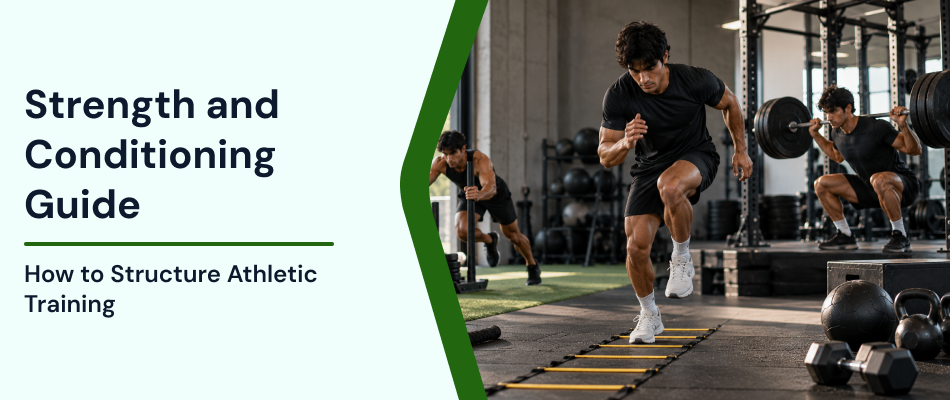
Whether you’re a competitive athlete or someone training to improve performance, understanding how to structure athletic training makes all the difference. The Institute of Nutrition and Fitness Sciences (INFS) provides science-based education on these principles. This guide breaks down the science of strength and conditioning for athletes in plain language, so you can build a program that actually works.
Compound Exercises Build Real Athletic Performance
Most people think strength training is about isolating muscles, doing bicep curls to build bigger arms, for example. But that’s not how your body actually works.
When you sprint, jump, or change direction, multiple muscle groups fire in precise sequences. Your body coordinates your legs, core, and upper body all at once.
This is why compound movements, like squats, deadlifts, and push-ups, build real athletic performance. They teach your nervous system to coordinate these patterns. They create whats called a "kinetic chain," where force generated by your legs transfers efficiently through your core to your upper body.
Core Strength: Your Foundation for Power
When people talk about "core," they usually mean six-pack abs. There is much more to the ‘core’, than that.
Your core is your lumbo-pelvic complex, the entire system of muscles around your spine and pelvis. Think of it as the central hub that transfers power from your lower body to your upper body.
A strong core :
-
Prevents energy loss during movement
-
Protects your spine under heavy loads
-
Improves jumping, sprinting, and change-of-direction ability
-
Reduces injury risk
The key is training your core the right way. Forget endless crunches. Athletic core training focuses on resisting unwanted movement:
-
Anti-extension work: Training your core to resist arching backward
-
Anti-rotation work: Training your core to resist twisting
-
Anti-flexion work: Training your core to resist bending forward
A rigid, stable core keeps you efficient. Its like a strong foundation for a building.
How Much Training Volume and Intensity Do You Need?
Heres where training gets confusing. People argue about frequency, sets, and rep ranges. But research is clear on what actually matters: total weekly volume.
Your muscles adapt to cumulative stress. Think of volume as the total amount of weight you lift across all your sets and reps in a week.
The numbers:
-
Minimum: At least 4 sets per muscle group per week to maintain strength
-
For muscle growth: 10-20 sets per muscle group per week
-
Rep ranges that work: Anything from 6-15 reps works for strength. Even lighter weight (up to 40 reps) works if you take it close to failure
The intensity (how heavy) matters less than consistency. A lighter weight taken to failure creates similar muscle-building signals as heavy weight. What matters is effort.
What this means: You dont need to be a powerlifter to get strong. You need consistent volume week after week.
How Conditioning and Energy Systems Work
Most athletes know they need to lift. Fewer understand how athletic conditioning training actually works at a cellular level.
When you do intense exercise, your body produces lactate. For decades, people thought lactate was just waste. Its not. Lactate acts like a signaling molecule that tells your body to adapt. High-intensity interval training (HIIT) spikes lactate, which triggers your cells to build more mitochondria, the powerhouses of your cells. More mitochondria = better aerobic fitness.
But heres the critical part: the order matters.
If you do aerobic work (steady-state cardio) before strength training, it can actually blunt your strength gains. This happens because aerobic work activates different cellular pathways that interfere with muscle-building signals.
The solution: Always do strength training first, then conditioning afterward. This maximizes both adaptations.
Injury Prevention Through Progressive Training
The best injury prevention is a well-designed training program.
Injuries happen when tissues arent strong enough for the demands placed on them. If your tendons are weak, cutting movements in sports can tear them. If your stabilizing muscles arent conditioned, your joints become unstable.
Progressive resistance training fixes this. When you gradually increase load, you stimulate collagen synthesis, basically thickening your tendons and ligaments. Thicker connective tissue can handle higher forces.
Plyometrics (jump drills) and resisted sprints also build whats called "mechanical stiffness", the ability of your joints and muscles to stay stable during high-speed movements. This is why elite programs combine strength training with explosive movements.
The bottom line: Structured training prevents injuries better than anything else.
Periodization: Training Cycles That Work
Your body doesnt adapt linearly. Training one way forever leads to plateaus.
A proper strength and conditioning periodization guide for athletes uses the “impulse response model”: every workout creates immediate fatigue plus slower, long-term fitness gains. Performance = fitness minus fatigue.
To avoid chronic fatigue and keep progressing:
-
Program 2 sessions per week with progression (high volume or intensity) to create adaptation stimulus
-
Balance with 1 session per week for maintenance or active recovery, allowing your body to clear metabolic waste and restore energy
This just means alternating hard weeks with easier weeks. Tools like tracking perceived effort (how hard it felt) help you adjust daily loads based on how ready your nervous system is.
Recovery: Where the Real Gains Happen
Heres something people get wrong: adaptation happens during rest and not during the workout.
Your muscles grow during sleep, not in the gym. Your strength improves when you recover, not when you lift.
Recovery requires:
-
Sleep: 7-9 hours per night, prioritizing deep sleep when growth hormone peaks
-
Protein: 1.8-2.2 grams per kilogram of body weight per day, spread across meals
-
Consistency: The same training week after week, allowing cumulative adaptations
These recovery principles apply across all ages and athletic levels. Learn more about how training principles adapt at later life stages.
Conclusion
You now understand the principles. Strength training works. Conditioning works. Recovery is non-negotiable.
At the Institute of Nutrition and Fitness Sciences (INFS), we help athletes build evidence-based strength and conditioning programs.
Interested in how to become a certified strength coach? Our certified strength and conditioning coach course is available as strength and conditioning certification online, study at your own pace and master evidence-based training principles.
Certified Strength and Conditioning Coach Course – INFS
Ready to optimize your training? Connect with INFS for a personalized program designed for your specific goals.
Frequently Asked Questions
A tempo technique: 3 seconds lowering, 3 seconds pause at bottom, 3 seconds lifting. Creates more time under tension and forces controlled form. Demands lighter weight but builds more muscle.
Progressive overload, specificity, variation, recovery, individual differences, consistency, and compound movements. These seven principles form the foundation of all effective athletic training.
Disclaimer
This article is for educational purposes only and is not a substitute for professional medical advice. Always consult your doctor, registered dietitian, or certified fitness professional before starting any new exercise program or making significant dietary changes, especially if you have pre-existing health conditions, injuries, or are on medications.
References
2. Zhu, F. et al. The effect of school-based functional training for physical fitness and postural health among children: a school-based cluster intervention trial. Sci. Rep. 16, 1535 (2025).
3. Conditioning Strength Training for Peak Performance. Acceleration https://accelerationaustralia.com.au/conditioning-strength-training-for-peak-performance/ (2025).
4. Hughes, D. C., Ellefsen, S. & Baar, K. Adaptations to Endurance and Strength Training. Cold Spring Harb. Perspect. Med. 8, a029769 (2018).
5. Managing Fatigue in Team Sports - A Brief Review of Concurrent Training Effects Within The Microcycle | PDF | Strength Training | Muscle Hypertrophy. Scribd https://www.scribd.com/document/920276388/Managing-Fatigue-in-Team-Sports-a-Brief-Review-of-Concurrent-Training-Effects-Within-the-Microcycle.
6. Bandara, U. et al. What is the effect of strength and conditioning training interventions on mechanical stiffness? A systematic review and meta-analysis. J. Sports Sci. 43, 776–795 (2025).
7. (PDF) The Role of Strength and Conditioning in Supporting Athletic Performance, Mitigating Injury Risk, and Enhancing Health: A Narrative Opinion. ResearchGate https://doi.org/10.1519/SSC.0000000000000984 (2026) doi:10.1519/SSC.0000000000000984.
8. Imbach, F., Perrey, S., Chailan, R., Meline, T. & Candau, R. Training load responses modelling and model generalisation in elite sports. Sci. Rep. 12, 1586 (2022).
9. (PDF) Eccentric exercise as a training modality: A brief review. ResearchGate https://www.researchgate.net/publication/281103262_Eccentric_exercise_as_a_training_modality_A_brief_review.