
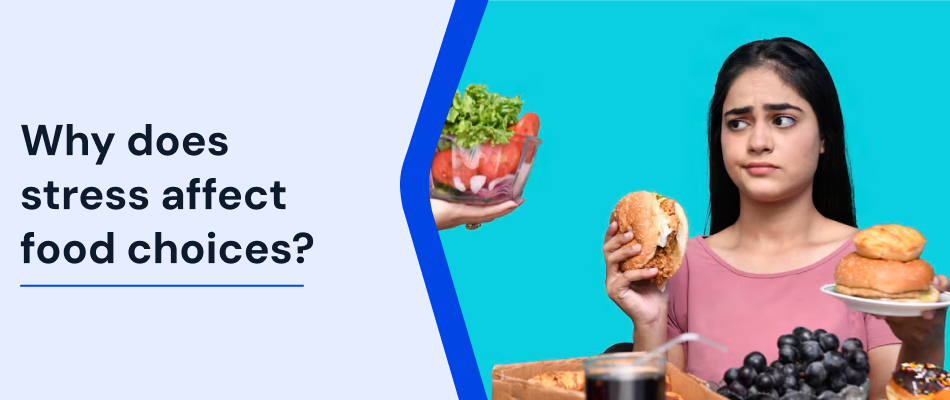
Stress happens to everyone. It is an integral part of our life. Work stress. Family stress. Money stress. Health stress. All kinds of stress.
But here is something most people do not know. Stress changes your eating pattern.
- Stress changes what you eat.
- It changes when you eat.
- It changes why you eat.
You eat more when stressed. You want different foods. You want comfort foods. This is not your fault. Your body does this automatically.
Understanding why helps you take control. The Institute of Nutrition and Fitness Sciences (INFS) emphasizes that recognizing the stress-eating connection is the first step toward breaking the cycle and making healthier food choices. This guide explains it simply.
The Stress-Eating Connection
When something stressful happens, your body reacts. Your heart beats faster. Your muscles tense. Your hands get sweaty. Your breathing quickens.
This is your body preparing to handle danger. This response worked great for our ancestors. They faced real physical threats. They needed to fight or run.
But modern stress is different. Your boss gives you a deadline. Your family has conflict. You worry about bills. Your body still reacts the same way. Like you are in danger. Even though you are not.
This matters for food choices.
How Stress Affects Your Appetite
Immediate Stress (Short-Term)
When stress hits suddenly, something odd happens. You feel less hungry. Your appetite goes down.
Your body shifts into survival mode. It does not think about eating. It thinks about handling the threat. Digestion is not important right now.
This usually passes quickly. Once the immediate stress ends, hunger returns.
Long-Term Stress (Weeks or Months)
But when stress lasts a long time, everything changes.
Your body produces a hormone called cortisol. Cortisol keeps you ready for continued problems. It stays high for days. Sometimes weeks.
Cortisol does something important. It increases your appetite. It makes you hungry. It makes you crave specific foods. Foods with sugar. Foods with fat. Foods with processed carbs.
Your body thinks. Store energy. You might need it. Cortisol wants you to eat. Eat now. Eat a lot.
This is the problem. This is why stress eating happens. Chronically elevated cortisol also promotes the storage of visceral adiposity, a metabolically active form of fat strongly associated with type 2 diabetes, cardiovascular disease, and chronic inflammation.
How Does Stress Change Your Brain?
Your brain controls what you want to eat. Not just hunger. Your cravings. Your choices. Stress changes your brain.
The Reward System
When you are stressed, your brain wants to feel better fast. Comfort foods make you feel better. They trigger a happy chemical called dopamine.
So your brain learns. Stressed equals eat comfort food equals feel better. Your brain remembers this. Next time you stress, your brain says. Eat that food again.
The pattern gets stronger every time you do it. You stress eat once. You stress eat twice. By the tenth time, it is automatic. Your brain expects it.
Self-Control Goes Down
Stress also weakens the part of your brain that says no. The part that plans. The part that controls impulses. This region, called the prefrontal cortex, is responsible for executive function, planning, decision-making, and self-regulation.
When this part is weak, resisting cravings is hard. Saying no is hard. Choosing healthy food is hard.
You feel like you have no willpower. Actually, your brain is just stressed. It needs help.
Emotional Hunger vs Physical Hunger
This is the most important part. Emotional hunger vs physical hunger are totally different.
Learning this changes everything.
Physical Hunger
Physical hunger builds slowly. Over hours. Your stomach might growl. You think about food gradually.
Many foods satisfy it. A salad. Chicken. Bread. Vegetables. Whatever.
After you eat, you feel satisfied. The hunger goes away. You stop eating.
Physical hunger makes sense. Your body needs fuel. Simple.
Emotional Hunger
Emotional hunger hits fast. Suddenly. Like a switch. No warning.
You want specific foods. Not just any food. Chips. Ice cream. Pizza. Chocolate. Your comfort foods.
You eat the whole bowl. The whole box. But you still want more. Even though you are full. Even though your stomach hurts.
Eating does not help. The feeling does not go away. Because the problem is not hunger. The problem is emotions. Stress. Sadness. Anxiety. Loneliness.
The key difference. Physical hunger is patient. Emotional hunger is urgent.
But not everyone handles emotional hunger the same way. Your personality matters. Your past experiences matter. Your emotional intelligence matters.
Some people use food to cope with stress. They are more likely to overeat when stressed. Others have better coping skills. They handle stress without turning to food.
The good news. You are not stuck with your habits. Coping skills can be built. You can learn to handle stress better. Then food becomes less of a crutch.
Your Gut and Brain Talk to Each Other
Something amazing happens in your body. Your stomach talks to your brain. Yourbrain talks back. This is the gut-brain axis.
They are in constant conversation.
Stress Affects Your Gut
When you are stressed, your digestion changes. Your stomach tightens. Your intestines slow down. The bacteria in your gut change.
These bacteria are important. They affect your mood. They affect how you handle stress. They affect your hunger signals.
Bad stress affects bad bacteria growth. Bad bacteria make stress worse. A cycle starts.
Food Affects Your Stress
What you eat changes your gut bacteria. Good food helps good bacteria. Good bacteria help your mood. Better mood means less stress. Less stress means better food choices.
This cycle can be good or bad. You choose.
What Stress Eating Does to Your Health
Stress eating today affects tomorrow. And next year. And your whole life.
What Stress Eating Does to your health Right Now
Weight gain. Your metabolism slows when stressed. You store more fat.
Blood sugar problems. Processed foods spike your blood sugar. Then it crashes. You feel tired. You want more food.
Inflammation. Your body becomes inflamed. This affects everything. Your joints. Your digestion. Your mood.
Long-Term
Type 2 diabetes risk increases. Heart disease risk increases. Digestive problems develop. Nutrient deficiencies happen.
Your stress resilience worsens. You handle stress worse. You stress eat more. The cycle continues.
Your gut bacteria suffer. Your mood worsens. Your ability to cope decreases.
The longer the pattern continues, the harder it is to break.
Poor dietary quality during chronic stress also depletes critical nutrients involved in neurotransmitter synthesis, including omega-3 fatty acids, B vitamins, magnesium, zinc, and dietary fiber. This nutrient depletion further affects stress bearing capacity, creating a vicious cycle where poor nutrition worsens your ability to handle future stress.
What You Can Do About It
Knowledge is good. But action is better. Preventive health education gives you tools.
Eat Regular Meals
Do not skip meals. Skipping meals makes stress worse. Eating regular meals keeps your blood sugar stable.
Stable blood sugar means a stable mood. A stable mood means better choices.
Include protein. Include healthy fats. Include fiber. These keep you satisfied longer. These reduce cravings. Prioritize nutrients that support stress resilience: omega-3 fatty acids, B vitamins, magnesium, and zinc all support neurotransmitter synthesis and mood regulation.
Notice When You Are Stress Eating
Before you eat, pause. Ask one question. Am I physically hungry or emotionally hungry?
This simple question changes everything. If it is emotional hunger, eat is not the answer. Take a walk. Call a friend. Do deep breathing. Journal.
Move Your Body
Exercise is powerful. Really powerful. It reduces cortisol. It improves mood. It reduces stress.
Even a 20-minute walk helps. Even 10 minutes of stretching helps. Movement is medicine.
Sleep More
Poor sleep increases hunger. Poor sleep increases cravings. Poor sleep worsens stress.
Sleep is not a luxury. It is essential. Aim for 7 to 9 hours.
Develop Real Coping Strategies
When stress hits, have a plan. Not food. Real strategies.
Meditation. Deep breathing. Journaling. Walking. Talking to someone. Whatever works for you.
Practice these when you are calm. Then when stress hits, you know what to do.
Your personality shapes how you handle stress. Some people bounce back easily. Others struggle more. But here is what matters. You can build better coping skills.
Coping skills can be learned. They can be strengthened. Practice them when calm. Then when stress hits, they become automatic.
Building these skills is as important as changing what you eat. Your coping abilities directly affect your food choices. Invest in both.
Key Takeaways About Stress and Food Choices
- Stress changes how you eat through cortisol release and brain changes.
- It is biological. It is not about willpower or weakness.
- Acute stress suppresses appetite. Chronic stress increases it dramatically.
- Emotional hunger differs from physical hunger. Learn to spot the difference.
- Emotional hunger comes suddenly and craves comfort foods despite fullness.
- Physical hunger develops slowly and stops when you are satisfied.
- Stress weakens your prefrontal cortex, reducing self-control and impulse resistance.
- Your gut bacteria affect your mood, stress response, and hunger signals.
- Regular meals, exercise, and sleep are your first line of defense.
- Moving your body reduces cortisol and improves stress resilience.
- Coping strategies like meditation, journaling, and breathing work better than food.
- Preventive health practices training teaches you these tools and techniques.
- A gut health nutritionist course deepens your understanding of the stress-eating connection.
- Breaking the stress-eating cycle is possible. You have the power to change it.
Simple Steps to Break Your Stress-Eating Habit Today
You now understand how stress affects food choices. You know the difference between emotional and physical hunger. The next step is action.
Start with your environment. Your surroundings influence your choices.
Make stress eating harder. Make healthy eating easier:
- Stock your home and workspace with nutrient-dense foods. Keep whole grains, lean proteins, fruits, vegetables, nuts, and healthy fats visible and accessible.
- Remove highly processed snacks from easy reach. Put them out of sight.
- Take one 10-minute walk everyday.
- Get a good night of sleep.
These small changes add up. Preventive health practices training teaches you more
But start today. With what you know now. Your body will thank you.
Ready to Master Stress Eating and Gut Health?
Stop guessing. Stop struggling. Stop blaming yourself.
INFSs Certified Nutritionist Course teaches you the science behind stress eating, gut health, and sustainable nutrition strategies. Learn how to break the stress-eating cycle. Understand the gut-brain connection. Build real coping tools that work.
Whether you are looking to transform your own relationship with food or build a career helping others, this course gives you everything you need.
Explore more courses at infs.com/courses
Frequently Asked Questions
References
Stress and Health – The Nutrition Source
https://nutritionsource.hsph.harvard.edu/stress-and-health/
Stress and Eating (American Psychological Association)
https://www.apa.org
Eating Behavior and Stress: A Pathway to Obesity (PMC / NCBI)
https://pmc.ncbi.nlm.nih.gov/articles/PMC4026680/
How to Curb Your Stress Eating (Harvard Health Publishing)
https://www.health.harvard.edu/diet-and-nutrition/how-to-curb-your-stress-eating
https://pmc.ncbi.nlm.nih.gov/articles/PMC12924779/
Disclaimer
This article/blog is for educational purposes only and should not replace professional medical advice. Always consult a qualified healthcare provider or certified nutrition specialist before making significant changes to your diet, exercise routine, or health practices.