
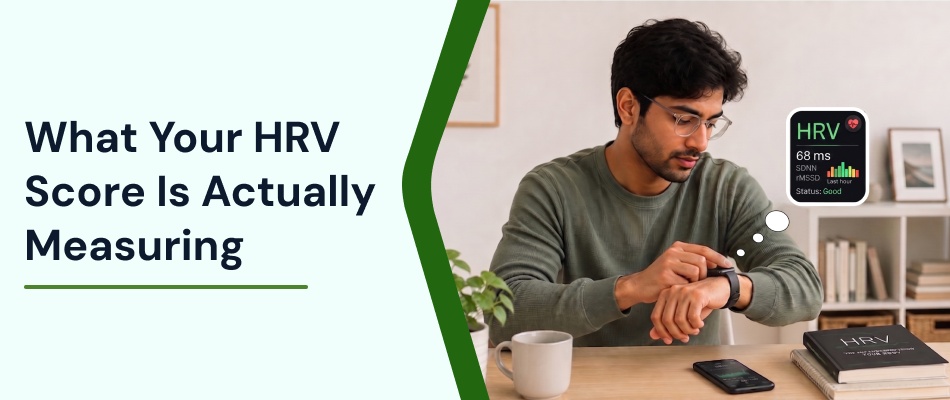
Your heart doesnt beat perfectly regularly, the intervals between beats naturally fluctuate to reflect your bodys ability to adjust to changing physiological and environmental demands.
At the Institute of Nutrition and Fitness Sciences (INFS), this blog explains what HRV actually measures. HRV is popular through wearables. But the science is more complex than one number. Understanding HRV helps you track trends without overreacting to single readings.
What HRV Score Measures
HRV quantifies the precise timing variation between successive interbeat (RR) intervals. For example, consecutive beats might measure 950 milliseconds, 1,020 milliseconds, 980 milliseconds, and 1,050 milliseconds.
These changes are partly influenced by the autonomic nervous system (ANS), which continuously adjusts cardiovascular function in response to internal and external demands.
What HRV score measures includes:
- Beat-to-beat timing variations
- Autonomic nervous system regulation
- Your bodys ability to adapt to stress and recovery
- Parasympathetic and sympathetic nervous system balance
HRV shows how your nervous system is working. But dont use it to measure stress. And dont use it alone to diagnose problems
Why is HRV important?
Your body is constantly responding to stress, from workouts to work deadlines to poor sleep. HRV is one window into how stressed or recovered your nervous system is.
Think of it this way: if your body is a phone battery, HRV tells you how much energy is left and how fast youre draining it. Low HRV might mean your battery is depleted. High HRV might mean youre charged and ready.
Why track it:
- Know when your body genuinely requires rest rather than relying on guesswork
- Make smarter training and recovery adjustments using objective data
- Understand your nervous systems stress capacity without expensive lab test.
- HRV wont tell you everything about your health. But its a useful clue about how your nervous system is managing stress and recovery.
Autonomic Nervous System and HRV
The autonomic nervous system regulates functions that largely occur without conscious control:
- Heart rate
- Blood pressure
- Digestion
- Breathing
Two branches are particularly relevant to understanding HRV:
- A sympathetic nervous system helps your body respond to demands such as exercise, acute stress, and other challenges.
- The parasympathetic nervous system supports resting and recovery functions. The vagus nerve plays an important role in cardiac regulation.
An important scientific clarification: HRV should not simply be interpreted as a measure of "sympathetic versus parasympathetic balance." HRV reflects interactions among several physiological regulatory systems, not just one simple balance.
Which HRV Metric Does Your Device Measure?
Different devices can report different HRV metrics. Understanding the measurement is important.
RMSSD (Root Mean Square of Successive Differences):
- Reflects short-term beat-to-beat variation
- Commonly used as an indicator of cardiac parasympathetic modulation
- Frequently reported by consumer wearables
- Can be useful for tracking changes in autonomic recovery
SDNN (Standard Deviation of Normal-to-Normal Intervals):
- Describes overall variability during a recording period
- Depends strongly on recording duration
- A five-minute SDNN and a 24-hour SDNN should not be treated as interchangeable measurements
Frequency domain measures: HRV can also be analyzed according to frequency components, including high-frequency (HF) power, low-frequency (LF) power, and very-low-frequency (VLF) power.
Normal HRV Score by Age
One of the most searched questions: Is there a "normal" HRV score by age?
The short answer: There is no single HRV value that defines optimal health for every person of a particular age.
HRV generally declines with increasing age, but substantial individual variation exists. Sex, physical fitness, health status, medications, measurement methods, posture, breathing, and recording duration can all affect HRV.
Why normal HRV score by age is misleading:
- A 25-year-old and 55-year-old should not necessarily have the same HRV
- Two healthy people of the same age may have very different values
- Individual variation is more important than age-based norms
For most people using HRV for fitness and recovery, the most useful information comes from comparing your own measurements with your personal baseline rather than comparing your number with someone elses.
How to Interpret HRV Readings
How to interpret HRV readings correctly depends on measurement consistency and trend analysis.
1. Choose a Consistent Measurement Period
Measure HRV under similar conditions whenever possible:
- At approximately the same time each day
- In the same body position
- Before exercise
- Before caffeine
- After waking or during sleep
- Under similar environmental conditions
Consistency reduces unnecessary variation.
2. Look at Trends, Not Single Readings
One unusually low HRV value does not necessarily mean poor recovery. HRV naturally fluctuates from day to day.
Instead, examine:
- Daily HRV patterns
- 7-day trends
- Longer-term baseline
A sustained decline is generally more informative than one isolated measurement.
3. Combine HRV With Other Information
How to interpret HRV readings requires context. Consider HRV alongside:
- Resting heart rate
- Sleep duration and quality
- Training load
- Exercise performance
- Perceived fatigue
- Muscle soreness
- Mood and stress
- Recent illness
- Alcohol intake
For example, a lower-than-usual HRV combined with increased resting heart rate, poor sleep, and unusual fatigue may suggest your body is experiencing greater physiological stress.
Getting Started: Your First Week of HRV Tracking
Day 1–3: Collect baseline data
- Measure your HRV each morning under the standardized conditions listed above.
- Record the score without attempting to analyze or optimize it yet.
Day 4–7: Observe initial trends
- Note day-to-day shifts alongside sleep quality, training load, and stress levels.
Week 2 and beyond: Guide your recovery
- Use your 7-day rolling average to establish a personal baseline range.
- Adjust training intensity only when sustained deviations from your normal baseline occur.
Can HRV Tell You Whether You Are Ready to Exercise?
HRV can be useful as one component of training and recovery monitoring, particularly when repeated measurements are collected under standardized conditions.
When HRV suggests continuing training:
- Stable HRV around your normal baseline
- Good sleep quality
- Normal energy levels
When HRV suggests reducing training:
- Substantial and sustained deviation from baseline
- Combined with fatigue or poor sleep
- Consistently elevated stress markers
Important caveat: HRV should not be treated as an autonomic "permission system" for exercise. A single low reading does not mean that exercise is unsafe, just as a high HRV does not guarantee that you are fully recovered.
Does Exercise Increase HRV?
Regular physical activity is generally associated with favorable changes in cardiac autonomic regulation. However, the immediate response to exercise is different from long-term adaptation.
Immediate response to exercise: After an acute bout of exercise, parasympathetic modulation can temporarily decrease while sympathetic activation increases. This is normal physiology.
Reductions in HRV measures such as RMSSD immediately after exercise are common, with the response influenced by exercise intensity, volume, and other training variables.
Long-term adaptation: With regular training and adequate recovery, improvements in autonomic function may occur over time.
Important distinction:
- Exercise can temporarily lower HRV
- Recovery restores HRV
- Consistent training may improve longer-term autonomic fitness
Therefore, dont assume that a lower HRV immediately after a workout means the workout was harmful.
How to Raise Your HRV Score
There is no scientifically validated "HRV hack" that guarantees a higher number. Instead, focus on behaviors that support cardiovascular and autonomic health:
- Prioritize Sleep Sleep disruption can substantially influence HRV. Consistent sleep duration and timing are important when monitoring your baseline.
- Exercise Regularly Both aerobic and resistance exercise contribute to cardiovascular fitness, although the acute HRV response varies according to exercise intensity and volume.
- Allow Adequate Recovery More exercise is not always better. Excessive training without sufficient recovery can increase physiological stress and temporarily suppress HRV.
- Manage Chronic Stress Breathing exercises, relaxation practices, mindfulness, and other stress-management approaches may influence autonomic regulation.
- Limit Excessive Alcohol Alcohol can adversely affect sleep and autonomic regulation and may produce noticeable reductions in overnight HRV.
- Maintain Overall Health Body weight, physical activity, illness, medications, and other lifestyle factors can influence HRV.
Key Takeaways
- Prioritize personal baselines: Individual trends matter far more than age-based norms or population averages.
- Evaluate context: Interpret HRV alongside resting heart rate, sleep quality, training volume, and perceived fatigue.
- Focus on multi-day trends: Guide training decisions using rolling averages rather than isolated daily spikes or drops.
- Expect acute workout drops: Temporary reductions in HRV after hard exercise are normal; long-term training enhances baseline autonomic fitness.
- Maintain consistent testing: Standardized morning measurement conditions yield the most reliable recovery insights.
Learn More About Recovery and Performance Monitoring
Explore INFSs preventive health education programs to master recovery and autonomic regulation. Certified Nutritionist Course: Understand how nutrition, sleep, and stress management support autonomic health and recovery.
Visit infs.com/courses to build expertise in athlete assessment and evidence-based health education today.
Frequently Asked Questions
- What is a good HRV score?
There is no universal "good" score. A good HRV represents your personal baseline under consistent measurement conditions. Track your own trends over time and compare changes with sleep quality, training load, and perceived fatigue.
- How do I raise my HRV score?
Focus on behaviors that support cardiovascular health: consistent sleep, regular exercise, adequate recovery, stress management, limited alcohol, and overall health. Sustainable improvements come from consistent lifestyle practices, not quick fixes.
- Does exercise increase HRV?
Regular exercise improves autonomic fitness long-term. However, HRV typically decreases immediately after exercise, this is normal. With adequate recovery and consistent training, autonomic fitness improves over time.
- What is more important: HRV or resting heart rate?
Neither is "more important", they answer different questions. Resting heart rate shows how fast your heart beats at rest. HRV shows timing variation and autonomic regulation. Use both together for complete context.
- Can HRV predict performance?
HRV is useful for monitoring training and recovery when measured consistently. However, dont treat it as an "exercise permission system." Combine HRV with sleep, resting heart rate, training load, and fatigue for a complete picture.
- Should I worry if my HRV drops after training?
No. A temporary HRV decrease after exercise is normal physiology. Your parasympathetic system activates during recovery, and HRV typically returns to baseline within hours. Repeated measurements over several days matter more than single readings.
- How often should I measure HRV?
Daily measurements under consistent conditions (same time, same position, before caffeine) establish trends. However, HRV naturally fluctuates. Examine 7-day trends rather than individual daily values.
Disclaimer
This article is for educational purposes only and should not replace professional medical advice. HRV is a monitoring tool, not a diagnostic test. Consult a qualified healthcare provider before making significant training changes. Seek immediate medical evaluation for chest pain, fainting, or severe symptoms.
References
An Overview of Heart Rate Variability Metrics and Norms (Shaffer & Ginsberg, 2017)
https://pubmed.ncbi.nlm.nih.gov/29034226/
An Introduction to Heart Rate Variability: Methodological Considerations and Clinical Applications (Billman et al., 2015)
https://www.frontiersin.org/