
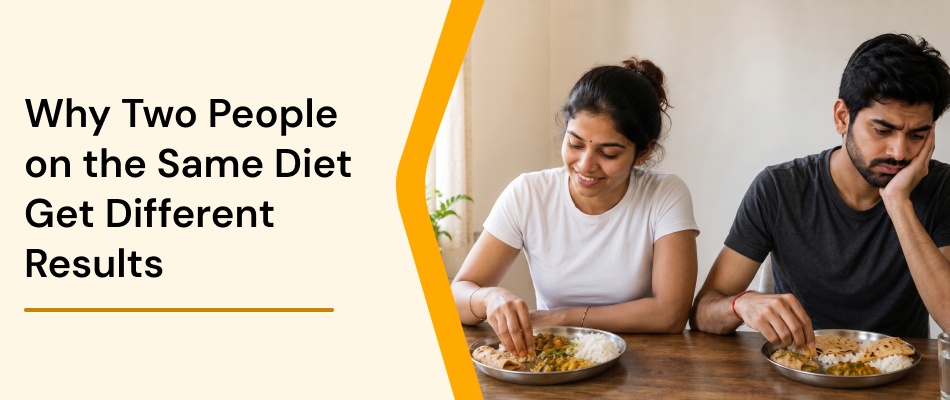
Research shows that diets work differently for people, which is normal and expected. In a large 12-month study of 609 adults, people on the same type of diet had very different results. Some people lost 30 kg while others gained 10 kg, even though they followed identical diet plans.
Understanding why diets work differently for people and why the same diet can produce different weight loss results is important. This is not about willpower or discipline. It is about how your body works differently from someone elses body.
At the Institute of Nutrition and Fitness Sciences (INFS), this blog explains why diets work differently for people.
Why Your Calorie Deficit Stops Working: The Adaptation Effect
Two people eating the same foods lose weight at different rates because their bodies need different amounts of energy. Your energy needs depend on muscle mass, fat mass, age, and thyroid hormones.
Weight loss is not linear. As you lose weight, your body needs fewer calories to function. The calorie target that worked initially may produce slower results later. Understanding metabolism speed and weight loss means recognizing your body adapts as you get smaller. This slowing is normal and does not mean the diet is broken.
Body Composition and Calorie Needs: Why Two People Lose Weight Differently
A larger body burns more calories at rest. Muscle burns more calories than fat, so two people of equal weight can have different energy needs based on muscle mass.
Two people eating identical meals lose weight at different speeds because starting bodies differ. One might have 15 kg more muscle, changing how the body uses energy.
Early scale changes confuse people. When you eat fewer carbohydrates, your body uses stored glycogen, which holds water. Losing glycogen means losing water weight, not body fat. This early water loss makes people question if the diet works.
Track trends over weeks, not days.
Diet Adherence vs Diet Label: Why Sticking to the Plan Matters Most
A written diet plan and actual eating are often different. A study of 811 adults tested four diets with different fat, protein, and carbohydrates. All produced similar weight loss, but people who attended support sessions lost more weight.
Sticking to an appropriate calorie level matters more than diet labels like low-fat or low-carb. Small behaviors affect calories: bigger portions, extra coffee with cream, different weekend eating, snacks, or less activity.
These are not moral failures, they are real-life changes. Good nutrition coaching measures what is happening and adjusts the plan instead of just restricting more.
Metabolic Adaptation and Weight Loss Plateaus: What Really Happens
When you eat less and lose weight, your energy expenditure changes slowly over months and years, not overnight. A calorie goal that worked initially might produce smaller weight loss later.
This does not mean you broke your metabolism. Your body adapts to changes, this is normal. When a plateau occurs, check food tracking accuracy, activity levels, sleep quality, and whether calorie reduction is still appropriate. Instead of cutting calories aggressively, measure and adjust based on real data.
A plateau signals the need to measure and adjust, not to give up or make extreme changes.
Personalized Diet vs Standard Diet
Personalized diet vs same diet distinction matters. Personalization means adjusting diet to fit your life: calorie needs, food preferences, culture, schedule, training, and what you can stick with. It does not mean everyone needs a special genetic diet.
Research shows genes and insulin levels do not predict which diet type works best. The real reason to personalize is simple: create the right calorie target for you, choose foods you like, and adjust based on results. Tailor the approach to how you live, not claiming biological superiority.
How to Track Progress and Adjust Your Diet Plan: The Real Guide
If two people on similar plans lose weight at different speeds, do not copy the faster persons strategy. Instead, look at several weeks of data for each person. Review body weight trends, measurements, food records, activity level, hunger level, training performance, and how well they are sticking to the plan. Only then adjust the individual program.
- Energy Target:
Calculate whether the planned calories create the right deficit for this specific person instead of giving everyone the same number.
- Protein and Food Quality:
Choose meals that feel satisfying and are nutritionally complete instead of focusing only on scale weight.
- Activity:
Look at both gym training and normal daily movement. Total energy burned is not just from workouts.
- Adherence:
Find patterns across the whole week. Look at meals eaten away from the plan, drinks, snacks, and portion changes.
- Medical Context:
When medicines, thyroid problems, digestive issues, or other health concerns exist, refer to a healthcare professional.
The goal is not to eliminate all individual differences. That is impossible. The goal is to measure progress accurately and adjust so the program fits the person, instead of forcing the person to fit a generic template.
Key Takeaways
- Same diet different weight loss results are expected and normal
- Two people create different calorie deficits even on identical plans
- Starting body size and muscle affect how quickly weight changes
- Sticking to the plan matters more than the diet label
- Your metabolism adapts over time; plateaus need measurement and adjustment
- Personalized diet vs same diet means fitting the approach to individual life
- Track your own trends over weeks; adjust based on your data
LEARN MORE
Different results on the same diet are not evidence that nutrition science has failed. They show why individual tracking matters more than averages. Progress depends on both your physiology and your behavior, not on following a one-size-fits-all diet. At INFS, we use evidence-based nutrition coaching to help you create an appropriate calorie target, track adherence, and adjust based on your real results.
Explore INFSs Certified Nutritionist Course to master personalized nutrition approaches and understand why diets work differently for people. Visit infs.com/courses to build expertise in evidence-based nutrition counseling today.
Frequently Asked Questions
- Does the same diet work for everyone?
No. Large research studies found that different diet types produce similar average weight loss, but individual results vary widely. The calorie level you need, how well you stick to the plan, your food preferences, and your personal progress all matter more than the diet label.
- Can the same diet have different results on similar people?
Yes, absolutely. Two people who look similar can have very different amounts of muscle, different resting energy needs, different daily activity levels, and eat different actual amounts even on the same written plan. Weight changes can vary widely even between people following the identical diet.
- Why is my weight loss slower than my friends on the same diet?
Factors affecting individual weight loss include basal metabolic rate, muscle mass, adherence differences, daily activity level, starting body composition, and how your body adapts to lower calories. A slower initial rate does not mean the diet is failing. It might mean a smaller calorie deficit or greater metabolic adaptation. Track your personal trends over several weeks before making changes.
Disclaimer
This article is for educational purposes only and should not replace professional medical advice. Always consult a qualified healthcare provider or certified nutrition specialist before making significant changes to your diet or starting a weight-loss program.
References
Gardner CD, Trepanowski JF, Del Gobbo LC, et al. Effect of Low-Fat vs Low-Carbohydrate Diet on 12-Month Weight Loss in Overweight Adults and the Association With Genotype Pattern or Insulin Secretion: The DIETFITS Randomized Clinical Trial. https://doi.org/10.1001/jama.2018.0245
Sacks FM, Bray GA, Carey VJ, et al. Comparison of Weight-Loss Diets with Different Compositions of Fat, Protein, and Carbohydrates. https://doi.org/10.1056/NEJMoa0804748
Hall KD, Sacks G, Chandramohan D, et al. Quantification of the Effect of Energy Imbalance on Bodyweight. https://doi.org/10.1016/S0140-6736(11)60812-X
Johnstone AM, Murison SD, Duncan JS, Rance KA, Speakman JR. Factors Influencing Variation in Basal Metabolic Rate Include Fat-Free Mass, Fat Mass, Age, and Circulating Thyroxine but Not Sex, Circulating Leptin, or Triiodothyronine. https://doi.org/10.1093/ajcn/82.5.941